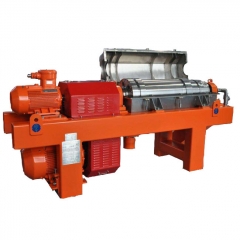
Decanter centrifuges are the final stage of drilling fluid solids control system, used to separate fine solids from drilling mud. They recover valuable barite while removing fine particles that can negatively impact drilling performance.
Min.Order Quant
Decanter centrifuges are the final stage of drilling fluid solids control system, used to separate fine solids from drilling mud. They recover valuable barite while removing fine particles that can negatively impact drilling performance. Types of decanter centrifuges Decanter centrifuges are categorized primarily by their operating speed and drive mechanism, which dictate their application.
High-speed decanter centrifuges
These centrifuges operate at high speeds, generating high centrifugal forces (G-force), and are used to separate fine solids from drilling mud, typically down to a size of 2–5 microns.
Features and design considerations When selecting a decanter centrifuge, several features are important for ensuring performance and durability.
Durable materials: Core components like the bowl and screw are often made from high-grade stainless steel, such as duplex stainless steel 2205 or 316L. Wear parts like the screw conveyor tiles are typically made from tungsten carbide for increased service life.
Corrosion resistance: All components that contact corrosive drilling fluid should have high anti-corrosion performance.
Explosion-proof design: For drilling operations where flammable and explosive substances are present, centrifuges with explosion-proof electric motors and control systems are necessary to ensure safety.
Control systems: Modern centrifuges use PLC-controlled VFD cabinets for real-time monitoring and automation. Features can include automatic start/stop and alarms for speed, torque, and vibration.
Bowl dimensions: The ratio of the centrifuge bowl's length to its diameter (L:D) is a key factor. A longer bowl increases the residence time for material, improving the separation effect, though a balance must be struck to prevent excessive turbulence.





 +86 1871 286 0976

 sales@jxsolidscontrol.com