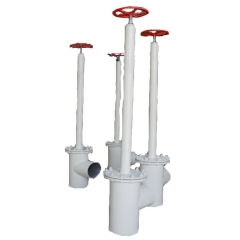
Suction valves used at the bottom of mud tanks to control each tank's drilling fluid or clear water's open and close.
MOQ: 1 set
Manufacture day: 50 sets/month
Delivery port: Tianjin Xingang Port
Payment" T/T, Westunion
A mud tank suction valve is a control valve installed within a drilling mud tank to regulate the flow of driling fluid during the solids control operation.These custom-fabricated valves are a critical component of the solids control system, which separates solid particles from the drilling fluid so it can be reused.
Function and operation The primary functions of a mud tank suction valve include:
Flow control: Controls the suction and discharge of drilling mud into and out of each tank compartment (bin).
Compartment isolation: Prevents different types of fluids in different bins from mixing by providing a reliable seal at the bottom of the tank.
Balance control: Allows for the balancing of fluid levels between bins when needed.
Surface operation: Operates via a handwheel or lever located on the top of the tank, connected to a lifting rod that opens and closes a valve plate at the tank's bottom.
Valve types and features
Mud tank suction valves are available in different configurations and can often be customized to meet specific needs.
Operation type
Screw-type operator (handwheel): A handwheel rotates a lead screw, moving the valve stem up and down to lift the valve plate. Early models often used this design.
Lever handle operator: A simpler, more space-efficient design preferred by many users.
Flow pattern
"Flow through" or elbow pattern: A straight-through design where fluid flows directly in line with the valve.
T-port pattern: Features a T-shaped suction port for increased mud flow capacity.
Cross-type pattern: Another design variant with a different suction port configuration.
Common specifications
Materials: Built to withstand abrasive drilling mud. Materials often include common carbon steel, seamless tube, or stainless steel.
Seals: Made from high-performance materials such as Viton synthetic rubber to resist high temperatures and oil.
Size: Common valve diameters include 6", 8", 10", and 12", with 8" and 10" being the most popular.
Customization: Valves can be customized for tank depth, suction height, and other specific requirements.





 +86 1871 286 0976

 sales@jxsolidscontrol.com