CNQ100 Hydrocyclone Desilter for Drilling Fluid Solids Control
Item No.: Desilter
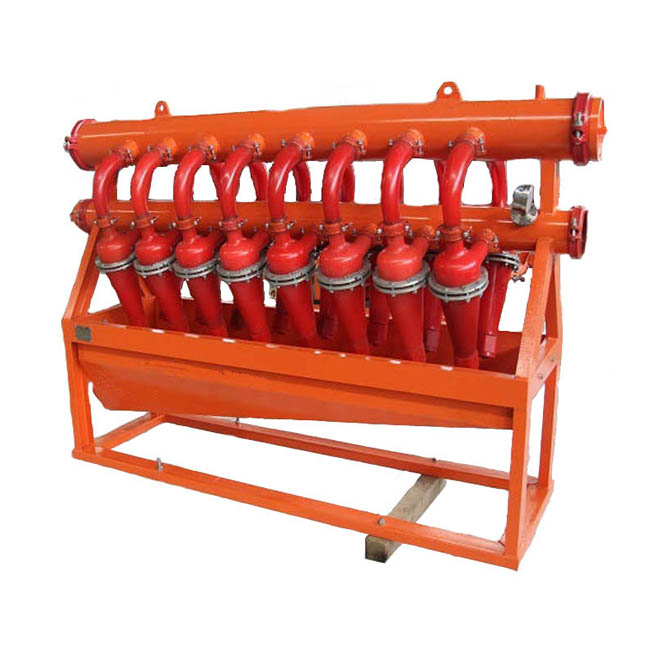
A hydrocyclone desilter is a solids control device used in oil and gas drilling to separate fine silt and sand particles from drilling fluid. A desilter is usually the third stage of a solids control system, used after a shale shaker and desander to clea
A hydrocyclone desilter is a solids control device used in oil and gas drilling to separate fine silt and sand particles from drilling fluid. A desilter is usually the third stage of a solids control system, used after a shale shaker and desander to clean the drilling fluid before it is reused. How a hydrocyclone desilter works A desilter utilizes centrifugal force to separate fine solids from the drilling fluid (mud).
A desilter pump feeds the drilling mud into a manifold that distributes the fluid to multiple small-diameter hydrocyclone cones, typically 4 or 5 inches in size.
The fluid enters the cones tangentially and at a specific pressure, creating a strong vortex or swirling motion.
Heavier, fine solid particles like silt are forced to the outer wall of the cones by centrifugal force and spiral downwards to exit through the bottom apex.
Lighter, cleaner fluid moves toward the center, creating an inner vortex that spirals upwards to exit through the overflow port at the top.
The separated solids at the bottom apex may be discharged onto a fine-mesh shaker for further processing and drying. The cleaner fluid is returned to the active mud system for reuse.
Desilter vs. desander Desilters and desanders both use hydrocyclone technology for solids removal but differ in the size of particles they target.
Cone size: Desilters use smaller cones (e.g., 4–5 inches in diameter), while desanders use larger cones (e.g., 8–12 inches in diameter).
Particle size: Smaller cones require higher feed pressure and can remove finer particles. Desilters typically remove solids in the 15 to 44 micron range, while desanders remove coarser solids between 45 and 74 microns.
System placement: Desanders operate before desilters to remove large, abrasive solids. Desilters are a later stage to remove remaining fine solids.
Application: Hydrocyclones, including desilters, are not used with weighted drilling fluids containing barite, as the valuable weighting material would also be separated and discarded.
When selecting and operating a desilter, consider the following factors:
Sizing: The desilter should have a handling capacity of 100% to 125% of the total mud load.
Pump flow rate: Match the desilter's cones to the feed pump to ensure proper flow and pressure. The optimal operating pressure for desilters in drilling is 30–50 psi.
Installation: Minimize friction loss in feed and discharge lines by keeping them short and straight. Ensure the overflow discharge line is angled correctly to prevent a vacuum effect.
Maintenance: Regular inspection of cones, seals, and pumps is necessary to ensure optimal separation efficiency and prevent downtime.




 +86 1871 286 0976

 sales@jxsolidscontrol.com